Compound interest calculator
Snowballr is a free financial planning toolkit with 60+ calculators and 40+ guides for retirement, debt payoff, savings, and investing. Visual charts, no sign-up, instant results — designed to make money math easy to see.
Crushing debt? Try our Debt Snowball calculator
See exactly how fast you can be debt-free using the Snowball or Avalanche method. Side-by-side comparison, payoff timeline, interest savings. New to the approach? Read what a snowball method is before comparing plans.
Try Debt Snowball →How compound interest works
Compound interest is the snowball effect for your money. It's the process where the interest you earn starts earning its own interest. Over long periods, this transforms modest savings into substantial wealth — just like a tiny snowball rolling down a mountain and gathering mass.
Unlike simple interest (which only earns on your original deposit), compound interest adds each period's earnings back to your balance. Next period's interest is then calculated on a bigger number. The longer you let it run, the more dramatic the effect.
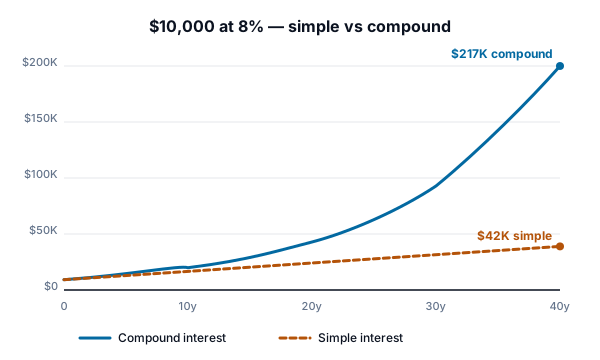
- S&P 500 annualized total return: about 10% nominal and 7% real after CPI-U inflation, with dividends reinvested, 1928–2025; a historical geometric result, not a forecast.
- Money doubles in: 9 years at 8%, 12 years at 6%, 6 years at 12% (Rule of 72).
- Illustrative monthly savings for a $1M goal at age 65: With $0 initially, fixed month-end deposits, and 7% nominal compounded monthly, the estimated monthly amount for $1M at age 65 is $381 from age 25, $555 from 30, $820 from 35, $1,234 from 40, or $1,920 from 45. Fees, taxes and inflation are excluded.
- Illustrative compound-growth example: From $0, $500 deposited each month-end for 30 years gives about $609,985 at a fixed 7% nominal rate or $347,025 at 4%, compounded monthly before fees, taxes and inflation.
- Investment fees: reduce the balance left invested; model their effect using your own assumptions.
- Retirement withdrawal guidelines: historical rules of thumb rely on specific assumptions and are not guarantees.
- Portfolio target: a multiple of annual expenses is a starting estimate, not a personalized retirement plan.
- Market risk: historical averages do not show the path an investor will experience; declines, timing, fees and taxes affect real outcomes.
- Lump sum vs dollar-cost averaging: Lump sum beat three equal monthly investments one month apart in 68% of one-year comparisons (Vanguard, MSCI World 1976–2022; 100% equities; no return on idle cash). Historical result, not a forecast.
- 2026 contribution limits: 401(k) $24,500, IRA $7,500, HSA $4,400 self-only / $8,750 family (eligible catch-ups: $8,000 for 401(k) at 50+, $11,250 instead at 60–63; IRA $1,100 at 50+; HSA $1,000 at 55+).
- Compound Interest
- Interest calculated on the initial principal plus all previously accumulated interest. Each period's interest becomes part of the base for the next period, producing exponential rather than linear growth. Example: $10,000 at 8% compounded annually grows to $21,589 in 10 years; the same at simple interest grows to only $18,000.
- Principal
- The original amount of money invested or borrowed, before any interest is added. In our calculator, the "Initial amount" field is the principal. Monthly contributions add to the principal over time as you invest.
- Compounding Frequency
- How often interest is calculated and added back to the principal: annually, semi-annually, quarterly, monthly, or daily. More frequent compounding produces slightly higher returns at the same nominal rate, with diminishing benefit as frequency increases. The actual convention is set by the account, loan or investment terms; compare APY where it applies and read the disclosure.
- Annual Percentage Yield (APY)
- The effective annual return on a deposit account, accounting for compounding within the year. APY is always greater than or equal to APR. Example: 5.00% APR compounded monthly equals 5.12% APY — the extra 0.12% comes from interest earning interest.
- Real Return
- Investment return adjusted for inflation, representing actual change in purchasing power. Quick formula: real return ≈ nominal return − inflation rate. An 8% nominal return at 3% inflation is roughly 5% real. For long-term planning, always think in real terms.
- Rule of 72
- A mental math shortcut for doubling time: divide 72 by your annual return rate to estimate how many years it takes for an investment to double. At 8%, money doubles every 9 years (72 ÷ 8); at 6%, every 12 years; at 12%, every 6 years.
The compound interest formula
Where:
- A = Final amount
- P = Principal (initial investment)
- r = Annual interest rate (as decimal)
- n = Number of times interest compounds per year
- t = Time in years
Our calculator handles this formula plus regular contributions (which the basic formula doesn't), giving you accurate projections for real-world investing scenarios.
Why time horizon matters more than rate of return
The single biggest variable in compound growth is not your interest rate — it's how long you stay invested. Doubling time from 20 to 40 years roughly quadruples your final balance at the same rate. A 1% higher return only adds about 30% over the same window. Time is the multiplier that small rate differences cannot match.
Consider two investors. Anna starts at 25, contributes $300 per month for 10 years, then stops entirely — total contributions $36,000. Ben waits until 35, contributes $300 per month for 30 straight years — total contributions $108,000. At an 8% return, Anna ends up with around $531,000 by age 65. Ben ends up with about $440,000. Anna invested one third as much money, but her ten-year head start let compounding do nearly all the work.
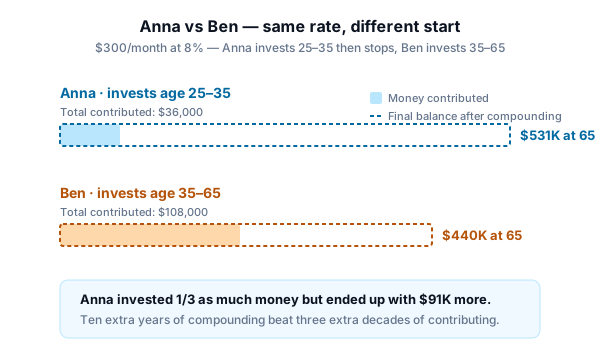
This is why financial planners obsess over starting early. Every year you delay isn't just a missed contribution — it's a missed doubling. Use our Rule of 72 guide to calculate exactly how long it takes your money to double at any given rate.
Choices that affect compound growth
Compound interest describes how a balance can grow when earnings are reinvested. Real investment outcomes are uncertain and depend on returns, fees, taxes, contribution timing and withdrawals. These points explain variables to consider; they are not a recommended portfolio or a prediction.
Common compounding mistakes that destroy returns
A calculator often holds the return constant, while real markets fluctuate. The examples below show why assumptions, costs and personal circumstances matter.
How inflation affects your real return
Nominal amounts are stated in future dollars. To express a result in today's purchasing power, adjust it for an assumed inflation rate over the same period. For one year, the exact relationship is (1 + nominal return) ÷ (1 + inflation) − 1; subtracting the rates is only an approximation. Any inflation input is a scenario, not a forecast.
When inflation exceeds an account's yield, cash loses purchasing power; yields and prices change over time. Investment returns also vary and can be negative, so historical results do not establish what will outperform over a future period. Use our inflation calculator to see exactly how much purchasing power you stand to lose.
How compounding works in different account types
The same compounding math applies whether your money sits in a savings account, a brokerage, or a retirement plan — but taxes and fees can dramatically change your real outcome. A taxable brokerage account may receive different tax treatment for interest, dividends and gains. Traditional retirement accounts generally defer tax until distributions; qualified Roth distributions can be tax-free when applicable requirements are met. Check current rules for the account and your circumstances.
An HSA's tax treatment depends on eligibility and qualified expenses. Its rules differ from retirement accounts, and investment options, fees and access to funds vary by provider. Review current IRS guidance and plan terms before relying on a particular tax treatment.
High-yield savings accounts (HYSAs) compound daily on cash, with a variable yield that depends on the provider and market conditions. They can fit emergency funds and short-term goals where you cannot afford a market drawdown. For long-term goals, compare a range of after-tax outcomes because equity returns and cash yields both vary.
Choosing an asset mix
A mix of stocks, bonds and cash can affect both risk and potential return. The right mix depends on your goals, time horizon, need for liquidity, ability to tolerate losses, other resources and account rules. Age-based formulas are rough shortcuts; they do not account for each person's circumstances or guarantee a particular outcome.
Target-date funds generally adjust their asset mix over time; their glide paths, holdings and fees differ. A multi-fund portfolio can combine domestic, international and fixed-income investments, but diversification and cost depend on the actual holdings. Review current fund documents and plan options before choosing.
Rebalancing can bring a portfolio closer to a chosen allocation, but frequency, transaction costs and tax consequences vary. Some funds and plans manage the mix internally; check their terms to understand how and when changes occur.
For a simple inflation illustration, $50,000 compounded at 3% inflation for 30 years is about $121,000 in future dollars. This is only a scenario, not an inflation forecast or a retirement spending recommendation. Use our retirement calculator to model both nominal and inflation-adjusted scenarios.
Step-by-step: how to use this compound interest calculator
Enter your own amounts, timing and assumptions to see a mathematical projection. The calculator does not predict future investment returns.
- Step 1
Enter your initial amount
Input what you have already saved or plan to deposit today. If you're starting from zero, leave it at $0 — the calculator handles pure monthly contributions just fine. Example: $5,000 already in a brokerage account.
- Step 2
Set your monthly contribution
The amount and timing of future deposits. You can model a fixed monthly amount, but the result does not set a savings target or account for every change in income or expenses.
- Step 3
Choose an annual interest rate
Choose an explicit rate assumption for the scenario you want to model. Different assets and accounts have different risks; past returns and current yields are not guarantees of future results. If a deposit product quotes an effective APY, make sure the calculator input convention matches it.
- Step 4
Set the time period
The number of years you'll let the investment compound. For retirement, this is the gap between your current age and target retirement age. Compounding rewards patience: 30 years produces dramatically more than 20 years at the same rate, because the doublings stack at the end.
- Step 5
Optionally model inflation
Set an inflation assumption to compare the nominal balance with an estimate in today's purchasing power. Inflation is uncertain; use more than one scenario if you want to see how sensitive the result is.
- Step 6
Read the chart and year-by-year breakdown
The chart compares deposits and projected growth over time. The year-by-year table shows how the balance changes under your selected assumptions; it cannot show the actual path of future market returns.
Want to model debt payoff instead? Use our debt snowball calculator. Need to plan retirement specifically? Try the retirement calculator with built-in 4% rule logic.
Quick answers to common questions
These are mathematical illustrations with stated assumptions. They do not forecast future investment returns; taxes, fees and inflation can change real outcomes.
How much will I have if I invest $500 a month for 30 years?
+
What if I invest $10,000 today and never add another dollar?
+
How long until I have $1 million if I save $1,000 a month?
+
Can I retire on $500,000?
+
What happens if I delay investing by 5 years?
+
Is investing $100 a month even worth it?
+
How much do I need to retire at age 50?
+
What's the difference between investing $500 and $1,000 per month?
+
How much should I have saved by age 30?
+
What if the market crashes right after I invest?
+
Frequently asked questions
What is a good annual return to use in my calculation?
+
How often should interest compound for best results?
+
Does this calculator account for inflation?
+
How accurate are these projections?
+
Should I invest a lump sum or dollar-cost average?
+
What's the difference between APR and APY?
+
How much do I need to save monthly to retire as a millionaire?
+
Should I prioritize a Roth IRA or a traditional 401(k)?
+
What happens to my projection if there's a market crash?
+
Does the calculator work for cryptocurrencies and individual stocks?
+
How do taxes and fees affect my final balance?
+
Sources & methodology
Historical return figures and policy limits use the sources below. Other balances on this page are calculated examples with their assumptions stated; they are not sourced forecasts. The 2026 tax limits and homepage scenarios were checked October 11, 2026.
- S&P 500 annualized geometric total returns (~10% nominal, ~7% real, dividends reinvested, 1928–2025). Compiled by NYU Stern School of Business (Damodaran historical return dataset). Cross-verified with Robert Shiller's long-run stock data, Yale University.
- 4% withdrawal guideline and 25× shortcut. Trinity Study (Cooley, Hubbard, Walz, 1998), “Retirement Savings: Choosing a Withdrawal Rate That Is Sustainable,” AAII Journal. Original publication. The study tests historical outcomes under stated assumptions; it does not guarantee future results.
- Lump sum vs a three-month cost-averaging split. Vanguard Research, “Cost averaging: Invest now or temporarily hold your cash?” (2023). Figure 2 compares a lump sum with three equal investments one month apart, over a one-year horizon using the MSCI World Index for 1976–2022; the illustration assumes 100% equities and no return on uninvested cash. Vanguard research paper (PDF).
- Snowball method completion-rate research. Gal & McShane, “Can Small Victories Help Win the War? Evidence from Consumer Debt Management,” Journal of Marketing Research, 2012. The study concerns a debt-settlement setting and does not guarantee a completion advantage for every household. Journal of Marketing Research.
- 2026 contribution limits (401(k) $24,500, IRA $7,500, HSA $4,400 self-only / $8,750 family). Internal Revenue Service annual COLA adjustments, IRS Retirement Plans and IRS 2026 HSA limits. HSA catch-up eligibility is in IRS Publication 969; 401(k) catch-up amounts are in the IRS catch-up contribution guidance. See the 2026 limits guide for eligibility details.
Methodology note: Projections use compound-interest formulas with the inputs shown, including contribution timing and compounding frequency. Calculator results describe that scenario; historical averages do not establish expected or guaranteed future returns.