How fast can you be debt free?
Add your debts, pick a strategy, and watch your payoff plan come to life. The snowball method gives you fast wins. The avalanche saves more money. We show you both.
What is the debt snowball method?
The debt snowball method is a debt payoff strategy where you list your debts from smallest balance to largest (ignoring interest rates), pay the minimum on every debt except the smallest, and throw every extra dollar at the smallest debt until it's gone. Once paid off, you roll that payment into the next smallest debt — building momentum like a snowball.
Snowball vs Avalanche — which method wins?
Both methods work. Both get you debt-free. The question is: do you prioritize math or motivation? The debt avalanche (highest interest first) saves you the most money mathematically. The debt snowball (smallest balance first) gives you faster emotional wins that keep you going.
Early account milestones can make a repayment plan easier for some people to follow. A Kellogg summary of Gal and McShane's 2012 research linked account closures with completion among debt-settlement clients; that setting does not guarantee the same result for ordinary monthly repayment. If you've tried and failed before, snowball might be right for you. If you want to minimize interest under fixed assumptions, compare avalanche as well.
The debt snowball method (step-by-step)
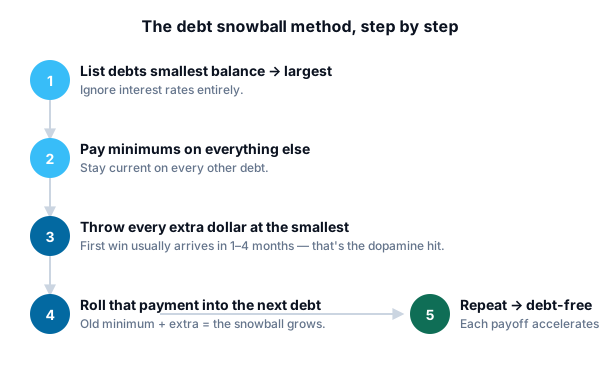
- List all your debts from smallest balance to largest (ignore interest rates).
- Pay the minimum on every debt except the smallest.
- Throw every extra dollar at the smallest debt until it's gone.
- Once paid off, take that debt's minimum payment + your extra payment, and apply it to the next smallest.
- Repeat. Each payoff accelerates the next. The snowball grows.
The debt avalanche method
- List all debts from highest interest rate to lowest.
- Pay minimums on everything except the highest-rate debt.
- Throw extra money at the highest-rate debt.
- Once gone, roll it all into the next highest rate.
- Mathematically optimal — saves the most in interest.
How much extra should I pay?
Even an extra $50/month makes a dramatic difference. But the real breakthrough comes from finding $200-500/month in extra payments. Here's where to look:
- Cancel subscriptions you don't use ($50-150/mo)
- Cook instead of takeout ($200-400/mo)
- Sell stuff you don't need (one-time $500-3000)
- Side hustle — even 10 hours/week at $15/hr = $600/mo
- Negotiate rent, insurance, phone bill (often 10-20% savings)
Pair this calculator with our compound interest calculator to see what that same money could do if you invested it after becoming debt-free. Spoiler: the numbers will motivate you.
Common questions
Should I invest or pay off debt first?
+
What about the emergency fund?
+
Should I consolidate my debts?
+
Can I use this for student loans and mortgages?
+
Turn that same payment into wealth
Once you're debt free, take that monthly payment you were throwing at debt and invest it instead. Use our compound interest calculator to see what happens.
See the growth →